Last updated November 17, 2026
DIY vs Professional ADU Builders: What’s Safe to Do Yourself
An owner-builder ADU in Nevada can save $40,000 – $80,000 in labor costs, and it can also permanently attach a disclosure flag to your property title that every future buyer’s agent will see before they make an offer. Both things are true at once. That’s the part most DIY guides leave out. In this guide we’ll walk through what Nevada’s owner-builder exemption actually permits, which parts of an ADU a homeowner can genuinely handle and still pass inspection, where the savings math falls apart, and where Summerlin homeowners get caught out by rules they never read. It’s written for people who are seriously weighing the tradeoff, not for people who just want permission to swing a hammer.
Quick Answer
In Nevada you can legally pull an owner-builder permit for your own ADU, but you cannot do licensed electrical, plumbing, or mechanical work yourself, and you must disclose the owner-builder status at resale. Safe DIY scope is limited to site prep, insulation after framing inspection, and finish carpentry. Everything structural, life-safety, and trade-licensed should go to a professional, and the long-term resale and lending consequences of a fully owner-built ADU usually outweigh the labor savings.
Table of Contents
- What Nevada’s Owner-Builder Exemption Actually Allows
- The Resale Disclosure That Follows the Property Forever
- The Three ADU Components That Are Genuinely Practical to DIY
- Where Licensed Labor Dominates Cost and Where Materials Do
- How Lenders Treat Owner-Built ADU Rental Income
- The Insurance Gap During and After an Owner-Build
- Summerlin-Specific Conditions That Change the Math
- How to Decide Which Route Fits Your Lot and Budget
What Nevada’s Owner-Builder Exemption Actually Allows
Nevada law lets a homeowner act as their own general contractor on a property they own and will occupy. That means you can pull the building permit in your own name, hire subcontractors directly, and manage the schedule and budget yourself. It does not turn you into a licensed contractor, and it does not let you do the trades.
The line most people miss: electrical, plumbing, and mechanical work – HVAC, gas, and anything covered by a specialty license – must be performed by a licensed contractor, even on an owner-builder project. You can hire those subs yourself, but you can’t wire the panel, run the gas line, or install the mini-split refrigerant lines. Under NRS 624.3016, working outside the owner-builder exemption (say, building an ADU you intend to rent or sell from the start) can be treated as unlicensed contracting, which carries real penalties.
Here’s the practical breakdown of what the exemption does and doesn’t cover:
- You can: pull the permit as owner-builder, act as your own GC, hire and schedule licensed subs, do non-licensed labor yourself, and manage inspections.
- You can’t: perform licensed electrical, plumbing, or mechanical work, or build for resale or rental under the owner-builder label.
- You must: occupy the property as your principal residence, and disclose the owner-builder status when you sell.
For a Summerlin homeowner planning a detached ADU on a half-acre lot in The Ridges or a garage conversion in Redpoint, the exemption is real, but it’s narrow. It gives you project management authority, not trade authority. That distinction is where a lot of people overestimate what they can save.
The Resale Disclosure That Follows the Property Forever
When you sell a home with an owner-built structure, you must disclose that the ADU was constructed under an owner-builder exemption. That disclosure doesn’t dissolve after a few years. It travels with the property through every future transaction, and buyer’s agents read it before their clients make an offer.
What that does in practice: it invites a longer inspection period, more negotiation, and in some cases a lower offer or a financing snag. A professionally built ADU with permits and inspection records from a licensed general contractor reads as straightforward value on a listing sheet. An owner-builder ADU reads as a question mark. In a Summerlin market where buyers pay a premium for finished, documented improvements, that question mark costs you.
The disclosure is also a real insurance and lending trigger, not just a marketing inconvenience. Lenders reviewing the property for a purchase or refinance may ask for additional documentation on an owner-built structure, and some will discount or exclude the ADU’s value entirely if the paper trail is thin. Here’s what to have ready if you do go the owner-builder route:
- Copies of every permit, inspection sign-off, and final certificate of occupancy.
- Invoices and license numbers from every subcontractor who touched the project.
- Photos of the build at framing, rough-in, and finish stages.
- A written record of who performed which scope of work.
If that list sounds like running a small construction company’s back office, that’s because it is. The record-keeping burden is the hidden cost of the exemption. It’s also why we walk every Summerlin client through the professional permit and inspection pipeline in plain terms, so nothing on the disclosure side comes as a surprise at resale.
The Three ADU Components That Are Genuinely Practical to DIY
We’ve been on enough Summerlin ADU job sites to know where homeowner labor actually helps and where it doesn’t. The honest answer is that three components are worth doing yourself, and only if you have the time, tools, and patience to do them to inspection standard. Everything else is either life-safety-licensed or speed-critical.
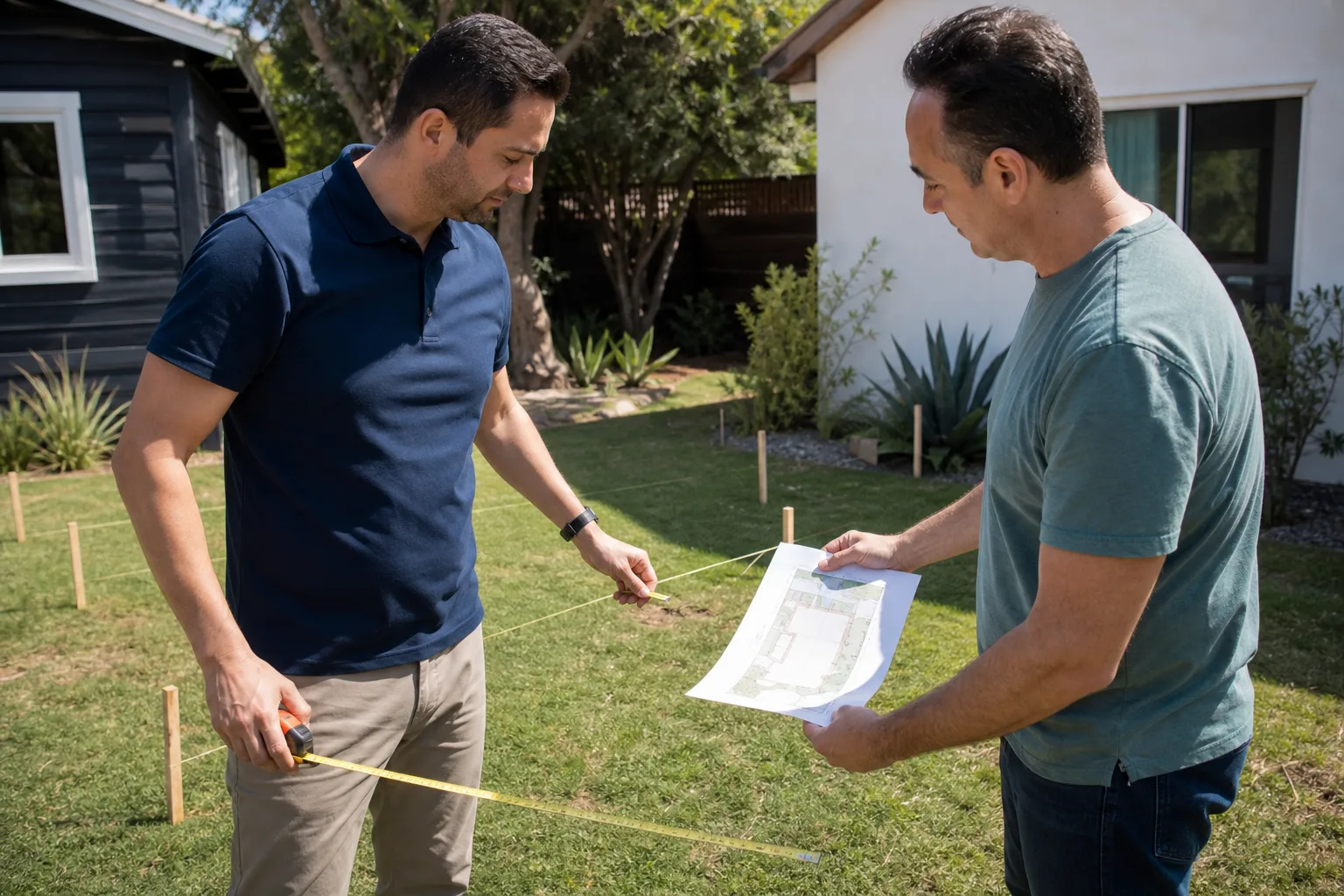
1. Site prep. Clearing the pad, marking the footprint, staging materials, and coordinating utility locates (call 811 before you dig) is legitimate homeowner work. It’s physical and unglamorous, but it doesn’t require a license and it has to happen before any subs arrive. On a Summerlin lot with caliche-heavy soil, expect to hit hardpan and budget for a jackhammer or a bobcat rental. That’s DIY-friendly labor.
2. Insulation after framing inspection. Once the framing passes inspection and the electrical and plumbing rough-in are signed off, you can install batt insulation yourself. It’s a scope that doesn’t affect structural or life-safety systems. Two cautions: it must meet Title 24-equivalent energy requirements for Nevada’s climate zone, and you’ll need to leave any required access panels and vent paths clear. Get the R-value spec from your plans before you buy a single roll.
3. Finish carpentry. Trim, baseboards, interior door hanging, cabinet installation, and paint are all things a careful homeowner with a good miter saw can do. They’re low-risk, high-satisfaction work, and they don’t require licensed trades. If a finish detail goes wrong, it’s cosmetic, not dangerous.
Here’s what’s not on that list, and we want to be blunt about it:
- Electrical panel work and wiring – licensed electrician only. Panel work is genuinely dangerous.
- Gas lines and plumbing rough-in – licensed plumber. Gas leaks and water damage aren’t DIY-recoverable.
- Mechanical / HVAC – licensed mechanical contractor. Mini-split refrigerant handling requires licensing and EPA certification.
- Structural framing, foundation, and shear walls – engineered scope. Wrong framing fails inspection and can fail under a Summerlin wind event.
- Roofing and any height work – fall risk is the leading cause of construction injury. Leave it to trained crews.
Our technicians have up to 20 years of experience on projects exactly like these, and a professional ADU build keeps every one of those licensed scopes with the people licensed to do them. That’s not a sales point. It’s the reason the inspection sign-off list stays clean.
Where Licensed Labor Dominates Cost and Where Materials Do
The DIY savings calculators you’ll find online usually assume you can substitute your own labor for the full labor line. You can’t. On a typical detached ADU, materials run roughly 40 to 50 percent of the total budget and labor runs the other half to 60 percent. But the labor line is dominated by licensed work you can’t legally do yourself, which collapses the theoretical savings.
Here’s a realistic look at a detached ADU in the 600 to 900 square foot range, which is the sweet spot for most Summerlin lots:
- Design and permit: $8,000 – $15,000 (professional; you can’t design your own structural plans)
- Site work including foundation: $25,000 – $45,000 (partly DIY-able site prep, but foundation is engineered)
- Framing and shell: $35,000 – $55,000 (licensed carpenters/GC)
- Electrical, plumbing, mechanical: $25,000 – $45,000 (licensed trades only)
- Insulation, drywall, finishes: $25,000 – $40,000 (insulation and finish carpentry are your DIY window)
- Site utility connections: $10,000 – $25,000 (licensed)
Total, most detached ADUs in this size range run $150,000 – $250,000 before site surprises, and larger or higher-spec units run well past that. The DIY ceiling on a project of this scope is realistically $15,000 to $30,000 – site prep, insulation, finish carpentry, and project-management coordination – not the $40,000 to $80,000 headline figure that gets quoted. The rest of the labor is licensed trade work you cannot legally touch.
Where does the money actually go? Licensed trades, engineered design, and foundation work. Where does material cost dominate? Framing lumber, windows, cladding systems, and finish materials. If you want to economize, you negotiate those material lines – a Plant Prefab or Tuff Shed shell can trim total cost versus a full stick-build – not the labor you can’t perform anyway. For a deeper look at realistic project totals, our ADU Builders in Summerlin page walks through the line items the way we quote them.
How Lenders Treat Owner-Built ADU Rental Income
If you’re planning to refinance, take a HELOC against the improved value, or eventually use ADU rental income to support a loan qualification, owner-builder status matters. Lenders looking at a professionally built ADU want to see permits, inspection records, and a licensed contractor of record. Owner-built ADUs with a thin paper trail sometimes don’t qualify for rental income consideration at all, regardless of whether the rent is real.
The reason is risk. An appraiser can’t easily establish the quality of construction on an owner-builder ADU without documentation, and lenders are conservative about counting income from a structure they can’t confidently value. That same appraiser is far more comfortable with a professionally built and documented unit, because the paper trail answers the “is this safe and to code” question before it’s asked. A professional build also means a written price locked in before work starts and a uniformed, background-checked crew on site – the kind of accountability lenders like to see on a project file.
If you’re considering a Summerlin ADU as rental income, the sequence matters:
- Talk to your lender before design, not after.
- Ask specifically how they treat ADU rental income on refinance and HELOC appraisals.
- Confirm what documentation they require for the build itself – permits, inspections, licensed contractor records.
- Build the documentation requirement into your project plan from day one.
A professionally built ADU clears that first-appraisal hurdle because the documentation already exists at close-out. That’s the practical reason the professional route often pays for itself in the lending side of the equation long before you get to resale.
The Insurance Gap During and After an Owner-Build
Standard homeowner’s policies do not automatically cover an active construction project. If you’re the owner-builder, your contractor’s general liability policy – the one that would normally cover a framework failure or a sub’s on-site injury – doesn’t exist, because there’s no contractor of record. That gap is the single most underprepared item on most DIY ADU plans.
What’s covered and what isn’t, plainly:
- During construction: Your dwelling policy may exclude structural damage during active construction, and it almost certainly won’t cover injuries to workers you’ve hired directly. A builder’s risk policy is what fills this gap, and you’ll usually need to coordinate it with a general liability policy too.
- Subcontractor injury: If a sub you hired directly is hurt on site and isn’t properly covered, you can be exposed. Require every sub to show you a certificate of insurance before work begins.
- After completion: Once the ADU is done and permitted, you need to add it to the dwelling coverage. An unlisted structure on the property may not be adequately covered.
A professionally managed build carries the contractor’s own liability and workers’ comp between your policy and the work, which is the reason we require every crew member on a Summerlin project to be background-checked, identity-verified, uniformed, and photo-badged with a name and photo sent to the homeowner before arrival. That’s the Home Addition Contractor in Summerlin standard, not a marketing layer, and it extends to how we handle the insurance side of the handoff at close-out.
If you’re determined to go owner-builder, budget for a builder’s risk policy and a general liability rider for the duration of the project. Expect several hundred to a couple of thousand dollars in policy cost depending on project scope and duration. That comes straight out of the labor savings you were counting on.
Summerlin-Specific Conditions That Change the Math
Summerlin has lot and design-review conditions that many national ADU guides never account for. If you’re converting a garage in The Trails or building a detached ADU in Redpoint or Summerlin West, the local layer matters.
Sun exposure and cooling load. Summerlin summers run past 105°F regularly, and an ADU’s cooling system carries a heavier load than the same square footage in a milder climate. That means a bigger mechanical system, more insulation (materials you can buy, licensed labor you can’t install), and a design that shades west-facing glass. HVAC is licensed mechanical work, so the part of the project driven hardest by local climate is the part you can’t DIY.
HOA and CC&R review. Many Summerlin sub-associations require design review for any new structure, including detached ADUs and garage conversions visible from the street. A DIY build that skips that step can be forced to modify or remove work after the fact. If your lot is subject to design review, confirm the process before you pull a permit.
Caliche and foundation cost. Summerlin’s soil is heavily caliche-laden, which is unforgiving on excavation. Expect engineered foundation depth and anchor design, not just a slab. That’s a professional scope.
Neighborhood-scale resale sensitivity. In a Summerlin community like The Ridges or Red Rock, the disclosure flag on an owner-builder ADU carries more weight because the buyer pool is high-end and expects documentation. A clean paper trail from a licensed contractor is what supports premium resale there.
Our Room Addition Contractor in Summerlin team handles this local layer as a matter of course, because it’s the layer that surprises DIY builders. It’s easier to plan for it than to fix it after the HOA letter arrives.
How to Decide Which Route Fits Your Lot and Budget
Here’s the decision framework we walk Summerlin homeowners through before they commit to a route. None of it requires you to call us, but it should inform whether you do.
- Confirm your lot can legally take an ADU. Zoning, HOA, CC&Rs, and setback requirements first, before any design work. A lot that can’t support a detached ADU changes the entire calculation.
- Price the licensed scope honestly. Add up electrical, plumbing, mechanical, foundation, framing, and roofing. That’s the majority of your project, and it’s the majority you can’t DIY.
- Add the DIY insurance cost. Builder’s risk plus a general liability rider. Subtract it from your theoretical labor savings.
- Check your lender’s stance. Ask before design, not after. Their answer on owner-builder ADU appraisal determines whether the resale value materializes.
- Read the disclosure language. Understand that NRS 624.3016 owner-builder resale disclosure attaches to the property, not the transaction.
- Compare against the professional build total. With a written price locked in before work starts and the 365-Day Done Right Promise on the finished work, the professional total is a known number. The owner-builder total is a moving target.
If the professional route wins after that exercise – and in our experience on Summerlin lots it usually does – the next step is a written estimate, not a handshake. Our Sutton ADU Builders Summerlin home page lays out the Threshold Standard, and our ADU Builders in Summerlin team can walk your lot and your budget in one visit. Every Sutton location is independently owned and operated under Threshold Verified standards, so the crew that shows up has been background-checked, identity-verified, and photo-badged before the first visit, and the price you sign is the price you pay.
Common Mistakes to Avoid
- Assuming the exemption covers trade work. It doesn’t. Electrical, plumbing, and mechanical are licensed-only even under owner-builder, and treating them as DIY is how an inspection fails and a fine lands.
- Building for rental under the owner-builder label. NRS 624.3016 treats building a rentable unit as unlicensed contracting. If someone else is paying rent, the exemption doesn’t apply.
- Skipping the HOA design review. Summerlin sub-associations often require it, and a skipped step can mean modifying or removing finished work after the fact.
- Forgetting the builder’s risk policy. Standard homeowner’s coverage doesn’t cover active construction or injured subs you hired directly. The gap is bigger than most people budget for.
- Underscoping the insulation R-value. Summerlin’s cooling load is heavy, and batt you install must meet the energy code for this climate zone. Too thin is a failed inspection and a hot ADU.
- Underestimating foundation cost on caliche soil. Summerlin lots hit hardpan and need engineered depth and anchors. A slab-on-grade estimate built for milder soil under-runs by tens of thousands.
- Assuming refinance income will count. Owner-built ADUs without a contractor record often don’t qualify for rental income in a lender’s appraisal. Confirm with your lender before you design.
When to Call a Professional
Call a professional when any of these apply: the project involves electrical, gas, plumbing, mechanical, foundation, or roof scope (which is most of it); your lender is counting on ADU rental income or HELOC value; your lot is subject to Summerlin HOA design review; you have a demanding day job or a young family and the schedule matters; or you simply can’t spare months of weekends coordinating inspections and subcontractors. The honest answer for most Summerlin homeowners is that the professional build is the lower-cost route once the insurance, lending, and resale-disclosure costs land on the owner-builder ledger. Sutton ADU Builders Summerlin offers free estimates in Summerlin. Call (833) 355-2818 to schedule your written estimate, and you’ll know the price before any tool is lifted. A live person answers every call, every hour of every day.
Frequently Asked Questions
Yes, if you own and occupy the property and pull the permit under the owner-builder exemption, and you still hire licensed contractors for all electrical, plumbing, and mechanical work. You cannot use the exemption to build an ADU you intend to rent or sell, and you must disclose the owner-builder status at resale under NRS 624.3016. Call (833) 355-2818 for an exact quote on the professional route – estimates are free.
Realistically $15,000 – $30,000 on a typical detached ADU, not the $40,000 – $80,000 figures some calculators show, because roughly half to 60 percent of the labor is licensed trade work you cannot touch. Once you add builder’s risk insurance, refinance appraisal risk, and resale disclosure impact, the net savings shrink further. Call (833) 355-2818 for a written estimate that shows the full project total line by line.
Nevada requires you to disclose that an ADU was built under the owner-builder exemption when you sell, and that disclosure stays attached to the property through every future transaction. It can trigger extended inspections, financing difficulty, and in some cases a lower offer. It’s not a temporary flag. Call (833) 355-2818 if you want to understand how a professionally permitted build reads differently on a Summerlin resale.
Site prep (clearing, marking, utility locates), insulation after framing inspection, and finish carpentry are the practical DIY scope. Everything structural, life-safety, or trade-licensed – electrical, plumbing, gas, HVAC, foundation, roofing – needs a licensed professional, and that scope is the majority of the project. Call (833) 355-2818 to scope what’s safe for you to handle and what isn’t.
Usually yes, when the ADU is professionally built with permits, inspections, and a licensed contractor of record. Owner-built ADUs without that documentation sometimes don’t qualify for rental income consideration at all, because the lender can’t confidently value the structure. Confirm your lender’s requirements before design. Call (833) 355-2818 and we’ll walk you through what a Sutton build includes on the documentation side.
Often yes. Many Summerlin sub-associations require design review for any new structure, including detached ADUs and visible garage conversions, and a build that skips review can be forced to modify or remove work. Confirm your CC&Rs and design-review process before you pull a permit. Call (833) 355-2818 if you’d like to talk through what the design-review step looks like on a professional build.
The Bottom Line
Nevada’s owner-builder exemption lets you pull your own ADU permit, but it doesn’t let you do licensed trade work, and it attaches a resale disclosure to your property that travels through every future transaction. The genuinely DIY-safe scope is site prep, insulation, and finish carpentry – roughly $15,000 to $30,000 of a $150,000-plus project – with the rest dominated by licensed labor you can’t legally perform. Add builder’s risk insurance, refinance appraisal risk, and the resale flag, and the professional route usually wins on total cost. For a Summerlin homeowner, that’s the honest math. Call (833) 355-2818 for a free written estimate and a clear scope, and you’ll know the price before any work begins under the 365-Day Done Right Promise.
Written by the team at Sutton ADU Builders Summerlin.